hygienic malevolence
"he disparages no one, unaware of the

hygienic function of malevolence.”
hygienic function of malevolence.”



For example,
when Stalingrad happened
I sat at home as a child, listening to
our Minister of Propaganda, Goebbels,
who said, "Be proud
of these fallen young men,
for they died
for a great Germanic idea."
And then Beethoven's Fifth
started to play.
The composers after World War II
wanted to free the idea of music
from this kind of...
..magical usability.
They tried to redefine music
in an entirely new manner,
with the help of so-called
acoustic parameters.
This was met with considerable
resistance within society,
since music had had that role,
and still has today.
Music is some kind
of magical medium.
Music seems to be an area
where we abandon our thought processes
and give ourselves over to feelings.
And these composers, amongst them
Pierre Boulez, Karlheinz Stockhausen,
and my teacher, Luigi Nono,
these composers came up with a different
kind of programming, as it were.
For me, from this moment on, music
has always been charged with the task
of constantly re-evaluating the concept
of music and its role in society.
This was the start,
and it was an important challenge for me
to write music that
both evoked this magical medium
and at the same time broke through it,
or, in English, "suspended magic".
In German we say "broken magic".
There were always two aspects to it.
On the one hand,
a collectively encompassing one,
and at the same time the challenge
to charge our feelings with thoughts.
This means listening to music whilst
at the same time thinking about music.

“When people migrate, they take with them their seeds and their songs, and I think that essentially that’s pretty much all you’ll need when you get there…. (Um, well, I should amend that: there are other things that you’re going to need: a shaving kit and all that … a change of clothes would be important. But, you know, you get the point.)” - Tom Waits

I've just had a translation of a Yuri Herrera story published on the frankly wonderful Words Without Borders. The story was an interesting challenge because its tone is almost baroque at times, but the plot centres on a down-at-heel bricklayer who moonlights as a lucha libre fighter. It made me think a little bit of JT Leroy, but only a little bit.
Lots of other really interesting pieces by amazing writers (in partnership with some very good translators) in this edition of WWB, all about Drugs in Mexico. The bilingual option warms the heart.

Jaimy Gordon's 'Lord of Misrule' is on the Orange prize longlist. A book that I loved last year but struggled to place reviews for, I couldn't really tell why. It won the National Book Award in the states but UK editors even manage to be sniffy about this!
It's about a racing track in Indiana - low-level betting scams and an Amazing witch doctor character who cooks up 'medicines' for the horses. A wonderful and challenging blend of 1st and 3rd person, a feeling for how subject and object interrelate and that's what makes up a place. Compelling Woman writing (outcast Jewish American women with a feeling for their own bodies, women who commune with animals and the land, women who are scathing and funny as fuck). An over-educated Kathy Acker, lamenting the education, modulated by some of the wisdom of Kathleen Graeber, grounded in detail.
I'm interviewing her for 3am in the next few weeks, which is exciting. I hope both things will lead more people to her work - both 'Lord of Misrule' and others.

“Translation is an exact art. Exactitude and art are often exacting. They press exaction on the translator, to the
point, as Hölderlin, Walter Benjamin and Scott-Moncrieff tell us, of self-suppression, of near-derangement. The reader also should be under some pressure. At their best, the rewards are those of a radiant, ever-renewed dissatisfaction. They are, quite simply, those of love.”
From Among Translators: W.G. Sebald and Translation in the current issue of In Other Words.

'...Historically, any significant shift in poetry has been a shift ‘down’ – to the demotic, the current vernacular as experienced by readers... Such a shift usually involves taking the cues for writing directly from life, rather than from the canon of poetry with which the poet may be attempting to ingratiate himself... In the moments when it becomes culturally relevant or emblematic, poetry interrupts, derails, shifts; it does not reinforce. Yet the world one becomes familiar with if you aspire to write poems is quite different from anything these notions might suggest: a liberal establishment firmly in control of publishing channels, made up of bodies with decades of personal and professional investment in the type of poetry they write and write about. This would seem to explain the continuation in poetry of styles that have long outlived their reasonable lifespan...
...When a magazine or publisher that survives almost entirely on arts funding is unable to generate enough interest to support its own programme, the efforts of many internet zines/publishing houses/poets, operating almost entirely outside that framework of support, yet receiving an enviable quantity of traffic and attention, should at least be acknowledged...
...It can appear that ‘gatekeeping’ authorities artificially perpetuate a tradition of poetry simply because it is easy to do so, and within that define a comfortable notion of ‘quality’, to the point that it results in a genuine repression of what kind of poetry is being written. It is not an exaggeration to say, in the UK at least, that aspiring poets not only learn to write in accordance with a broadly accepted style, but also share broadly accepted aims, in order to increase their chances of publication. This seems to be a very effective way of strangling an art form, ensuring a certain tradition is bought into by emerging writers and remains the dominant one...
...Poetry has become used to positioning itself as an ‘anti-commercial’ mode of culture, a somehow economically untainted art form... Of course, no poetry publisher would actively discourage people from buying its books... [poetry] still operates with a structure of production and capital...
Here is George Szirtes discussing Riviere discussing a ''deliberate flatness and an almost obsessive use of qualifiers''... And, below, something I re-posted quite a while ago, with other reasons for refusing metaphor, writing 'pared-back' etc (go to 3:00 in), which I would say, despite Tao Lin's apparently almost congenital tendency toward these things, go back to big and important arguments about "the destitution of the old myths of depth" (Robbe Grillet)...

...the artist remained unknown and his work was to the glory of God. He lived and died more or less important than other artisans; 'eternal values,' 'immortality' and masterpiece were terms not applicable in his case. The ability to create was a gift. In such a world flourished invulnerable assurance and natural humility.
Today the individual has become the highest form and the greatest bane of artistic creation. The smallest wound or pain of the ego is examined under a microscope as if it were of eternal importance. The artist considers his isolation, his subjectivity, his individualism almost holy. Thus we finally gather in one large pen, where we stand and bleat about our loneliness without listening to each other and without realising we are smothering each other to death. The individualists stare into each other's eyes and yet deny the existence of each other.

“Unlike a work of literature, translation does not find itself in the centre of the language forest but on the outside facing the wooded ridge; it calls into it without entering it, aiming at that single spot where the echo is able to give, in its own language, the reverberation of the work of the alien one.”

At the risk of becoming little more than an HTML Giant fansite (possibly not the worst fate), I re-post Sean Lovelace's Cheever endings post, which is pretty cool.
Word of the day
aestivation | estivation, n.
Pronunciation:/ɛstɪˈveɪʃən//iːstɪˈveɪʃən/
Etymology:modern < Latin æstīvāt- participial stem of æstīvā-re (see aestivate v.), after nouns of action in -tion suffix, as if < Latin *æstīvātiōn-em. In the Bot. sense it is < modern Latin æstīvātio introduced by Linnæus. Lord Bacon spelt estivation, but the techn. spelling is commonly æstivation. As to the pronunciation of æ-, see aestival adj., and compare estimation, Latin æstimātio.
†1. The passing or spending of the summer; summer retreat or residence. Obs.
1625 Bacon Ess. (new ed.) xlv. 263 Let it be turned to a Grotta, or Place of Shade, or Estiuation.
1731 N. Bailey Universal Etymol. Eng. Dict. II, Æstivation, a dwelling or residence in a place for the summer time.
1755 Johnson Dict. Eng. Lang., Estivation, the act of passing the summer.
2. Zool. The act of remaining dormant or torpid during the dry season, or extreme heat of summer; summer-sleep. Opposed to hibernation. Also fig.
1839 C. Darwin in R. Fitzroy & C. Darwin Narr. Surv. Voy. H.M.S. Adventure & Beagle III. v. 116 Within the tropics, the hybernation, or more properly estivation, of animals is governed by the times of drought.
1870 Pall Mall Gaz. 12 Dec. 11 With what we are pleased to call the cold weather Calcutta rouses herself from her æstivation of seven long months.
3. Bot. Internal arrangement of a flower-bud; manner in which the petals are folded up therein before expansion; præfloration. Opposed to vernation, or the arrangement of the leaf-bud (flowers expanding in summer, and leaves in spring).
1830 J. Lindley Introd. Nat. Syst. Bot. 151 With Malvaceæ they agree in the twisted æstivation of the corolla.
?1877 F. E. Hulme Familiar Wild Flowers I. Summary p. vi, Meadow Crane's-Bill.‥ Calyx of five sepals, imbricate in æstivation.
I don't chime with everything Zizek says, and don't feel as compelled as some to pretend I know what it was all about, but this makes some sense to me:
Are the shopkeepers a small bourgeoisie defending their property against a genuine, if violent, protest against the system; or are they representatives of the working class, fighting the forces of social disintegration? Here too one should reject the demand to take sides. The truth is that the conflict was between two poles of the underprivileged: those who have succeeded in functioning within the system versus those who are too frustrated to go on trying.
Although this: The rioters’ violence was almost exclusively directed against their own. The cars burned and the shops looted were not in rich neighbourhoods, but in the rioters’ own. is actually incorrect. I was speaking to a Kurdish shop owner in Dalston (I've been staying with a friend there, and was waiting for him to get home), and this guy, apart from saying Mark Duggan was 'a bad lot' (a phrase my Dad uses!) because he used to come into another of his restaurants up near Angel, was categorically saying that the kids who came down to Dalston were not from there. They were conspicuous by their unfamiliarity to this shopowner and the others who chased the rioters/ shoplifters down the street. Therefore the idea of the rioters mindlessly shitting where they sleep just doesn't work.
Going back to the Zizek article, I thought this was beautiful and persuasive (and actually the article should have concluded here): It is impotent rage and despair masked as a display of force; it is envy masked as triumphant carnival.
A quote from a(nother) really rather excellent interview on 3ammagazine.com, this time with Gary Lutz, who I now want to read and find out all about.
A general strong impulse to read, sometimes. I stole a book from a friend, the other day, in a bit of a muddle of meaning to ask and the hour kind of getting too late and thinking I'd just put the book back on his shelf next time I was there, and also thinking of course I'd tell him. When I did tell him, I realised I'd really just stolen his book.
Time in the movies in different to time in the books, Lutz says. Which Joe Dunthorne also talks about, in a different way, in the interview I did with him a little while back for the Paris Review blog, which I've neglected to post here so far.

I was lucky enough to proof the text for the final edition of
this catalogue. Some beautiful work ,and really interesting to hear these young photographers reflecting on their own practice. Including this following episode, very possibly short story material, in my opinion.
Click.
I remember the click perfectly. My father was taking a photo of me and my sister and some friends in the garden when we were five or so years old, and I said I wanted to take one too.
OK, come over, my father said, look here, inside—see? You see the cross, the red cross, yes? And how, when I move it here, it shows a circle: only when you get the circle is it right, and you also need to make sure things look clear, not fuzzy. You have it? Yes? OK, press the shutter.
Click.
Again, Papa. I want to do it again.
My father laughing.
Since then, I have worked for magazines and people in many different countries, creating images and visual ideas in the shape of reportages, editorials, videos, exhibitions and books. Photography for me is a way of making seconds last forever. Documenting what I live, with whom, how—this helps me understand and reconstruct all those tiny things that I would otherwise forget: my work is constantly concerned with understanding the things I know I will never understand.
That first click has accompanied the visual documenting of my life—the camera I still use the most is that selfsame one on which I first learnt. Without it I know I would be lost.
The exhibition is on in Munich at the moment, although I think it might also be headed to NY shortly.

Best thing I've seen written over the last few weeks of Bob Dylan appreciation, from a big fan.
I first saw Dylan in 1964, in London. I was taken by a friend; we were 19, Dylan was 23. A scruffy little guy in jeans, he shambled out onto the stage at the Royal Albert Hall, where we sat in our red, plush 'Jerusalem' seats. With no back-up at all, nothing but guitar, harmonica and his songs, his music and his unlikely voice, he took the place, by storm, by magic, I can only say.
I particularly remember "It's all right, Ma, I'm only bleeding"! The intensity of his performance was stunning. He wove music and poetry together with a fierceness and a longing, a searching that pointed to the depths and heights of the human spirit, and with a refusal to be limited by conventions of music, or verse, or folk, or pop, or whatever. He was a conduit for the sense that, in the midst of the farce and stupidity of so much of the usual life, there are sublime possibilities. The role of the artist/shaman since Orpheus, I suppose.
The next summer, '65, I "did" the USA on Greyhound buses, to the rollicking humor of AM radio, everywhere playing the number one hit "Like a Rolling Stone" -- to be followed in '66 by "Everybody Must Get Stoned" ( aka Rainy Day Woman) -- the ultimate adolescent anthem, surely! Naughty and so much more fun than the Beach Boys.
I saw Dylan live a few other times. Some of the shows were bad. Bad, bad, bad. I gather he is famous for his unevenness. Good for him. Artists blow it sometimes. Muzak is even. One wonderful, stoned concert in Boston in the early 70s, with the one, the only, The Band, was electric fantastic, absolutely as good as that gets.
Then there's all the record stuff. The incredible collections of lines, starting out on Burgundy and widening you to God knows where? (A couple of bad albums, among 55 I heard! including some things to displease most of us along the way, not just the uptight Mr Jones.)
And then there has been just enjoying his music with friends, something about the bitter-sweet, often fleeting connections life affords? The most recent album I have heard, Modern Times, is pretty damn good.
For me, life would have been smaller and significantly less fun without the ballad of Bobby D.
Good interview with the always brilliant John Sutherland -- on the 'sociology of literature', on 'the inspectorial regimes' infesting the academy, and the 'greivous bodily harm' done to 'poor Ian McEwan' by his online critics, apparently a sort of Louis XVI for the internet reading revolution -- among other things. It's at www.literateur.com, which I've just discovered.

“Odd, that I, who say ‘no’ so much, cannot bear it from others. Odd, that I, who run from so many, cannot brook that one turn from me.”
From the Paris Review's interview with Emily Fragos, quoting the recently released volume of Emily Dickinson's letters, of which Fragos was editor.

From under Waterloo arches:
'The loves we share with a city are often secret loves... a certain volume of sunlight, the sea at the end of every street...'
'I know simply that this sky will last longer than I. And what shall I call eternity except what will continue after my death?... [B]eing pure is recovering that spiritual home where one can feel the world's relationship, where one's pulse-beats coincide with the violent throbbing of the two o'clock sun.'
'If there is a sin against life, it consists perhaps not so much in despairing of life as in hoping for another life and in eluding the implacable grandeur of this life'
'The contrary of a civilized nation is a creative nation.'
aqui
If you like that sort of thing.
by Albert Vigoleis Thelen TR by Donald O. White
(quotations from review by Iain Bamforth in TLS April 1)
"Small causes can often have large effects. Smaller causes can have even bigger effects, and the very biggest effects frequently have no cause at all. Witness, for example, the world. It was created out of nothing, and that has made it the worst calamity the world has ever seen."
"Happiness is an art mastered by the very few. Genuinely happy people are as rare as Christians who believe in God."
"Christianity, which had developed so gloriously and naturally out of the starvation edema of humankind, has degenerated at the hands of its own unnatural, self-satisfied, conceited scholarly theology."

Get it?
“But it is imperative, for our own survival, is that we avoid one another, and what more successful means of avoidance are there than words? Language will keep us safe from human onslaught, will express for us our regret at being unable to supply groceries or love or peace.”
Now?
I've read Tao Lin's novel, published [in Spain} by Alpha Decay. I could say a number of things. It's we'll written. It's strange. And, above all, frightening. The same sort of frightening as The Outsider or American Psycho. It's the worst kind of fear, because it gets into your body without you noticing. Like cold at altitude, or mine gas, something that might cause you to lose your fingers from frostbite, or fly through the air. I think of Haneke. In Haneke the important thing is not the ellipses of time, but the ellipses of emotion. In [Richard Yates] it's the total opposite. It's a cocktail of nihilism and playground sensibility. There's a lot that's emotionally invalid. It's like watching someone walking around without any legs or arms. It reveals that adolescence, like Eliot's April, is the cruelest age. That we're all adolescents. Something we already suspected. That purity exists only in the concentration camp. [Richard Yates] is a cruel and lovely novel. It make you hate the author. You feel sorry for him. It also makes you go on believing in literature.
* eso es una traduccion de un post en peripatetismos2.blogspot.com que me interesa
** This is a translation of a post I found interesting on peripatetismos2.blogspot.com. I wanted to post something there about Tao Lin's 'concrete slash literal' novelistic style (see post below), and surfaces, and the rejection of the realism credo (Robbe Grillet's "destitution of the old myths of 'depth'"), and how this might feed into people's love/hate of Tao. Translating the post was as far as I got... I thought the 'emotionally invalid' translation, followed by the limbless image was suggestive -- you could translate it as 'there's a lot of emotional invalidity', or even maybe 'there's a lot of emotional untruth/ falsity/ fabrication' (which feels closer to my idea of this writer's idea of Tao Lin, but would really be stretching the translation), but you'd lose that overlap.

...a person moving through the traces of others' existences trying to understand what catastrophe may have caused this emptiness and what condition may have shaped the inhabitants' lives?

For Instance? Well, for instance, what it means to be a man. In a city. In a century. In transition. In a mass. Transformed by science. Under organized power. Subject to tremendous controls. In a condition caused by mechanization. After the late failure of radical hopes. In a society that was no community and devalued the person. Owing to the multiplied power of numbers which made the self negligible. Which spent military billions against foreign enemies but would not pay for order at home... You--you yourself are a child of this mass and a brother to all the rest. Or else an ingrate, dilettante, idiot.

There is a funny moment in the version I am reading of 'Your Face Tomorrow' by Javier Marías where the veneer of the translation thins, twice in one page, and the translator seems to be glimpsed at work.
#1 is in the 3rd part of the book's middle section,'Spear':'He felt once more in control of the situation after a brief moment of disequilibrium.' Spot the odd word out. Desequilibrio in Spanish, well, you can probably guess what it means -- wordreference.com has it as 'imbalance' or 'inequality'. The fact that an English speaker might guess what it means is evidence of the languages' shared roots, and perhaps accounts for why it was allowed to remain, rather than being replaced by something less weirdly archaic/ un-English in feel -- like 'imbalance', or a re-ordering of the sentence into something like: 'after a brief, unbalanced, moment.'
#2 'Wheeler did not reply directly. The truth is that he rarely did.' In Spanish you often use 'la verdad es que' as an emphatic preface, but how often do you do that in English? Really, you just say 'Really'. Right?
I had a sense of the translator at work. I felt I glimpsed her between the text and me, whereas so much of the time she, like any accomplished translator, achieved the illusion of not having done the work at all. I had a sense of Margaret Jull Costa maybe having pushed herself a bit hard one day, and ending up translating more literally than she had up until then or would after; an idea of her, in a space, at a computer or with printouts late at night, translating loosely, saying to herself, 'that's too loose', going and making tea and coming back to it refreshed, but just starting up again after those two slips, by accident, or finding her linguistic reservoir dry, and for some reason skipping this part.
Also interesting is that I don't feel you can say the translations are 'too' literal, or uniformly 'too' loose, but what they certainly can be accused of is deviating from the standards the translator has set up; they mirror the Spanish to an extent at odds with the standards of transparency, of the illusion of transcription, already set.
I could be wrong and Jull Costa could have intended both of these -- Marías himself could have sanctioned this imposition of Spanish-isms into English, for all I know. But it was just fascinating -- like a typo on subtitles, like the programme you're watching on iplayer glitching -- suddenly to be removed from the flow, the sense of sequence, the immersion in the rhythm of the text, and to be made aware of the translator, there, in between the text and the reading you.
"We have been the aggressors from the beginning, and like all other aggressors we shall never forgive them the injuries we have done them."
03:24 "...I think that people might not understand all the time that it's a conscious choice to really work to strip your writing of anything that's like a way that something is commonly expressed..."

You audition one after another and then when something sounds right — when a voice is properly absorptive, is symbiotic with the story being told — you try to hold onto it as hard as you can.

HERE
This from Rachel Seiffert's thoughtful contribution in today's Guardian:
The city turning fleshy is an arresting idea, but after they've become bodies, the buildings do little to justify their transformation. In the west [of Berlin] they are voluptuous, in the east they are grey and aged, and then, towards the end of the book, Margaret notices that they are brick and stucco again. Similarly, Frau Goebbels-as-hawk is appropriately creepy, but while she stalks Margaret through many scenes, none of them adds a great deal to the plot.
When Margaret goes to see her doctor, she says she can't sleep for guilt.
"Why do you feel guilty?"
"Because the residue comes off on me. My job has become horrible. I feel sick."
Here, perhaps, is the rub: there is more than enough in the stories themselves, in their contemplation, to disturb. For this reader, there was no need for so much literal, lurid madness; in fact it rather got in the way.
This, for me, was quite enough to puncture the whole enterprise. Its merits were theoretical, and therefore out of place in a fiction. Seiffert ends with this, with which I couldn't agree more:
But where the book is good, it is very good, and I hope that for her next, Hattemer-Higgins has the confidence in her material, and in her obvious talents, to allow her narrative to speak a little more than her narrator.
In a book... its seeking movement has to be there in the language. There is no epic literature without a lyrical element.
Peter Handke interviewed in Zeit
...listened and lip-synced to Lady Gaga's Telephone while exfiltratrating [sic] possibly the largest data spillage in american history...

'The neuronal pathways of reason and emotion are so intricately connected as to be virtually indistinguishable' Lakoff and Johnson

this time for introducing Amelia Gray, who beautifully described the ‘shifting impulses’ in the making of a story:
B: Once you have your idea, say, babies, how do you go about “writing your way out of it”? How do you know when you are “out”?
A: In the story I wrote about babies called “Babies,” I started with an ordinary fear of accidental pregnancy and unwilling parents and put it into the context of an irrational fear, where the baby is immediately there and there’s no time to have serious conversations or hold a baby shower or make a doctor’s appointment. The ordinary fear combines with the irrational fear and sets off a rational string of events. Obviously the woman is going to want to clean everything up. The baby is hungry, there’s no food in the house. That’s a more comic story, things are lightly touched. I could have made it more about umbilical cord infections or traumatic blood loss or flesh ripping or whatever, but I wanted to keep the real bumping up against the unreal, babies floating inside balloons. At the end I felt the impulse to make it a happy story, where the relationship is saved and the individuals are improved, and then I felt the impulse to crush that impulse in as few words as possible, and then I felt I was out. I had the plot of that story down fast, so I remember the impulses shifting. That’s not how it always goes but it’s how it went then.
Lovely, that.

Aqui
And aqui a sort of interview with David Means at the Paris Review, promisingly entitled 'Why David Means is Not a Novelist' - in fact it feels a bit half-baked to me, bit of a missed opportunity: why not get the author to talk a bit more specifically about the differences between novel and short story, and about his own processes in relation to those differences? Feels a bit like he was sent an email, can you talk a bit about x, and it might have been worth folowing up hs reply asking further question. Still worth a look though.

So, there's been quite a lot said about Tom McCarthy and his necronautical postures and impostures over the last couple of years. Much of it interesting, even if the Booker nomination did have the air of an establishment apologizing for having been caught out - we know you know we know you know Remainder had to go via an arthouse publisher, etc - because C was never going to win.
I didn't actually know Necronauts launched, a la Futurists 90 years earlier, with an ad on the front page of the Times. And I didn't, therefore, know how beautiful what Necronauts had to say about death was.

"They look in a field and see a cow and they think it's a better cow than the one in their own field, and it never really works out that way."
- Sir Alex Ferguson, 22.10.10

Mario Vargas Llosa on the beautiful game.
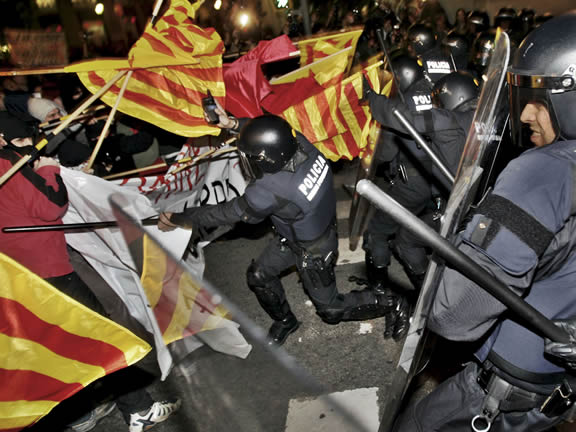
I like his hardheaded resistance to theorising, it's a nice kind of hardheadeness, but to state that the football pitch 'is a world without wars', particularly since the article was written sitting on the stands of the Camp Nou, is pretty unsatisfactory। During the Dictatorship, why did Franco turn a blind eye to the expression of Catalan nationalism only when they were expressed in the form of football songs? Señor VL, premiado o no, football is not simply 'exciting and empty'. By no means.

"Memories are very short. It is United States and the West which created this. In 1979, we launch an offensive against the Soviets -- why did United States and the West come into it? Who call you there? You came in there, to defeat the Soviets, with your own interests in mind. You wanted the Soviets to be defeated there. You launched a jihad there. You called it a jihad to draw mujahedeen from the Muslim world. And 30,000 mujahedeen came there. You armed them -- and then the Taleban were armed and trained and sent inside. You used Pakistan to do that. So please, let us understand, let us not have any short memories.This is what happened, and Pakistan suffered. And the people who fought against the Soviets, all the elites with the good suits and ties, left Afghanistan, they flew. they abandoned Afghanistan, they came to United States and Europe. The religious militant groups fought the Soviets. They spearheaded it, for you. And they defeated, for you. For the West -- but now they are fighting the West -- yes indeed. Because of the blunder in '89. We defeated the Soviet Union -- when I say we, you, the West -- and Pakistan in the lead role. We defeated them in 1989. What happened then? Refresh our memories: everyone left abandoned. Because maybe the strategic focus was Eurocentric. It was also backed [by] NATO, it was Berlin Wall, reunification of Germany, Cold War, East VS West. Everyone left. And what happened in the next twelve years, '89 to '2001, to 9/11? No rehabilitation, no resettlement of 30,000 warriors, mujahedeen, brought by us, and left there. Armed to the teeth, only know how to fight. Whose fault? The fault of the West! What did Pakistan and Afghanistan get from this? The victory that we fought, for you, what did we get? 4 million refugees in Pakistan, 25-30,000 mujahedeen, including Osama Bin Laden, become Al Qaeda. And then 1996, Taleban get created. Who has done all this? And Pakistan is all alone, fending for itself, against all this turmoil in Afghanistan -- what is happening in Afghanistan? Tajeks, Uzbeks, Hazaras, and then the Pashtuns 50% -- altogether 10 different factions -- Hyrcani group, Ul'Badeena group -- there are all these characters , fighting each other, destroying Afghanistan, and what is the impact on Afghanistan? Religious militancy. And then what happens? Kashmir starts, in 1989. And the public sympathy in Pakistan for their brethren in Kashmir. Therefore public sympathy [made for] dozens of muhajedeen groups emerging. All these youngsters who have never taken up weapons. They go to learn, and go to risk their lives to go and fight the Indians. Impact on Pakistan? Militancy. Religious militancy. This is what has happened to Pakistan. Please don't blame Pakistan."